> ## Documentation Index
> Fetch the complete documentation index at: https://docs.lovable.dev/llms.txt
> Use this file to discover all available pages before exploring further.
# Welcome to Lovable
> Lovable is a full-stack AI development platform for building, iterating on, and deploying web applications using natural language, with real code, security, and enterprise governance.
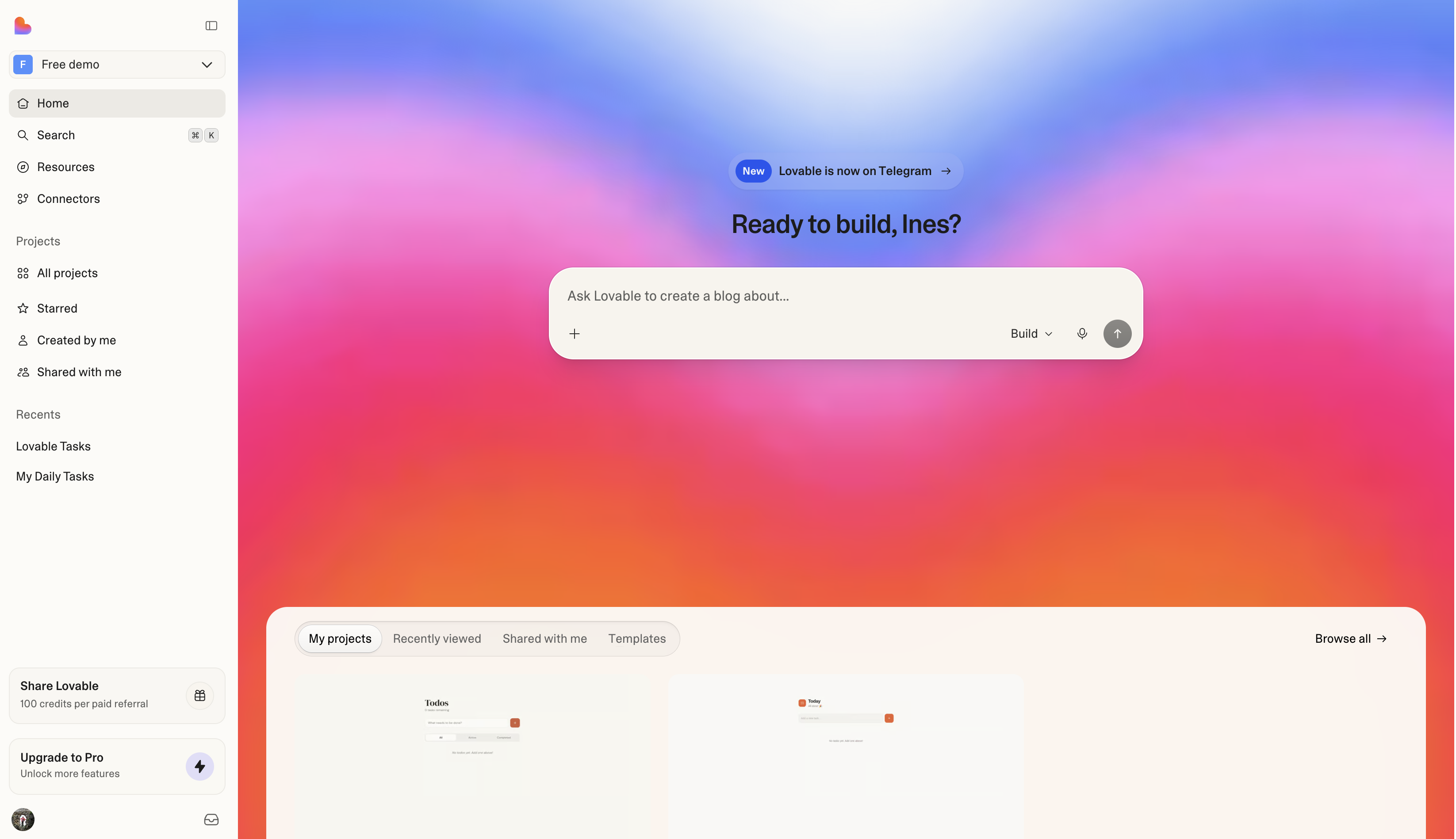 Lovable lets individuals and teams build production-grade web applications using natural language. You describe what you want to build, and Lovable generates a working application that includes frontend, backend, database, authentication, and integrations, all backed by editable code.
Lovable supports the full lifecycle of modern product development, from early exploration and prototyping to deployment and ongoing operation.
Applications are built inside shared [workspaces](/features/workspace), where a group of people builds from one plan and a shared pool of credits, each working on one or more of their own projects. Each project represents a single application and produces a codebase that can be synced to GitHub, GitLab, or Bitbucket with [Git sync](/integrations/git-sync-overview) and integrated into existing engineering workflows. The platform is built to help people move faster while maintaining ownership, security, and operational control.
You can start for free, and plans are priced by [credits](/introduction/credits-and-usage), not by projects or seats. See [Subscription plans](/introduction/subscription-plans).
Create a free account with email, Google, GitHub, or Apple, and start building immediately.
Build and publish your first app in about ten minutes.
Start from a ready-made app you can remix on any plan.
Free video walkthroughs and a guided learning path from the Lovable team.
## Core concepts
Four terms come up everywhere in Lovable:
* **Account**: Your personal identity on Lovable. You [log in with one account](/introduction/create-an-account) and use it across every workspace you belong to.
* **Workspace**: Where you and your team work. A [workspace](/features/workspace) holds projects, members, billing, and a shared pool of credits.
* **Project**: One app. Each [project](/features/projects/overview) holds its project chat, preview, code, and version history, and lives in exactly one workspace.
* **Chats**: Conversations with Lovable outside your projects, for thinking through ideas, asking about your apps, and working with connected tools. When something needs building, a [chat](/features/chats) sends the work to a project.
## Why use Lovable
Lovable makes it easier to go from an idea to working software.
**Faster iteration**\
Move from idea to working software by building through natural language instead of starting from a blank codebase.
**Collaboration when you need it**\
Work solo or with a team. Lovable supports shared workspaces so people across roles can contribute in one place when collaboration matters.
**Code ownership and flexibility**\
Keep full ownership of your code and integrate Lovable into existing workflows.
**Built with enterprise needs in mind**\
[Security, privacy, and governance capabilities](/introduction/lovable-for-enterprise) are built into the platform from the start.
## Who Lovable is for
Lovable is used by teams inside companies, by technical teams and agencies, across enterprises, and by people building on their own.
**Teams in companies**
* Product managers and designers turning prototypes into internal tools the business runs on
* Operations, sales, marketing, finance, and HR teams replacing spreadsheets and per-seat software with their own apps
* Marketers building landing pages, campaign sites, and dashboards
**Technical teams and agencies**
* Developers using Lovable to quickly set up projects, internal tools, and early prototypes
* Engineering teams reviewing, extending, and maintaining generated code through GitHub, GitLab, or Bitbucket
* Agencies and consultancies delivering client projects where code ownership and portability matter
**Enterprises**
* Teams building internal tools or business-critical applications used across the organization
* Organizations building and operating applications with [security, compliance, and governance](/introduction/lovable-for-enterprise) requirements
* Companies integrating AI-assisted development into established engineering workflows
**Individual builders**
* Founders and entrepreneurs launching products and reaching their first customers
* Independent makers building side projects, prototypes, or small products on their own
* Students and educators working on coursework, learning projects, or experiments
## What you can build with Lovable
Lovable supports a broad range of web applications, from early exploration to production systems, and also creates the presentations, documents, and visual assets around them.
**Prototypes and proofs of concept**\
Working prototypes with real data and logic, so product, design, and sales teams can validate an idea before engineering builds it
**SaaS and business applications**\
Subscription products, customer-facing dashboards, admin panels, CRMs, client portals, and multi-user applications
**Internal tools**\
Workflow tools, operational dashboards, and applications that replace spreadsheets or per-seat software for internal teams
**Dashboards and data visualization**\
Analytics dashboards, KPI and reporting views, and data visualization tools built on your existing data sources
**Marketplaces and online commerce**\
Booking tools, storefronts, and marketplace apps
**Consumer-facing web applications**\
Community platforms, content platforms, creative tools, and apps built for end users
**AI-powered apps**\
Chatbots, AI assistants, and apps with built-in [AI features](/features/ai) like image generation and semantic search
**Websites and marketing pages**\
Company websites, landing pages, campaign pages, portfolios, resumes, and event sites with invitations and RSVPs
**Educational tools**\
Learning tools, course platforms, student portals, and experiments
**Games and interactive content**\
Simple web-based games, quizzes, and simulations
**Presentations, reports, and documents**\
Pitch decks and client-facing presentations that present in the browser, plus generated files like PDF reports, spreadsheets, Word documents, and PowerPoint files
**Images, video, and design assets**\
Generated and edited images, logos, social graphics, and short videos for your apps and campaigns, used in the app or downloaded as files
## Security, privacy, and compliance
Lovable is built to meet enterprise security and compliance requirements. For the full picture of identity, governance, and auditability controls, see [Lovable for Enterprise](/introduction/lovable-for-enterprise).
### Certifications and standards
* SOC 2 Type II
* ISO 27001:2022
* AIUC-1, the security, safety, and reliability standard for AI agents
* GDPR compliance
[View compliance reports and security attestations](https://trust.lovable.dev/)
### Access and identity
* [Workspace-level roles and permissions](/features/collaboration)
* [Secure authentication with two-factor authentication (2FA)](/introduction/two-factor-authentication-2-fa)
* [Single sign-on (SSO)](/features/business/sso)
* [SCIM user provisioning](/features/business/scim)
* [Workspace groups](/features/groups)
### Platform security and governance
* [Workspace-level administration and controls](/features/privacy-and-security-settings)
* [Built-in security checks and guidance](/features/security)
* [Workspace-wide security oversight in the Security center](/features/security-center)
* [Audit logs](/features/audit-logs)
* [Workspace adoption metrics in Insights](/features/insights)
* [Sensitive data scanning](/features/sensitive-data-scanning)
* [EU inference for AI model requests](/features/eu-inference)
* [Data usage controls and data opt-out options](/features/business/data-opt-out)
[Learn more about Lovable’s approach to security](https://lovable.dev/security)
### Legal and data protection
* [Privacy Policy](https://lovable.dev/privacy)
* [Terms of Service](https://lovable.dev/terms)
* [Data Processing Agreement (DPA)](https://lovable.dev/data-processing-agreement)
* [Platform Rules](https://lovable.dev/platform-rules) and [Abuse Policies](https://lovable.dev/abuse)
## How Lovable fits into your workflow
Lovable is designed to complement existing tools and processes:
1. Describe what you want to build
2. Review and iterate on your app
3. [Publish](/features/publish) it to a live URL
4. When you want the code in your own pipeline, sync it to [GitHub, GitLab, or Bitbucket](/integrations/git-sync-overview) and deploy, operate, and govern to your standards
Lovable also works beyond the browser: build from the [desktop app](/integrations/desktop-app) or the [mobile app](/integrations/lovable-mobile-app), chat with Lovable in [Slack](/integrations/lovable-for-slack) or [Telegram](/tips-tricks/lovable-telegram-bot), start projects from [ChatGPT](/tips-tricks/chatgpt-app), and drive Lovable from your own AI tools with the [Lovable MCP server](/integrations/lovable-mcp-server).
Build and publish your first app in about ten minutes.
How to build a real product, from first idea to a live, growing app.
How projects work: create, organize, and publish.
Extend your apps with connectors.
Learn effective prompting strategies.
Learn the key terms.
## Get help
If a project shows an error, ask Lovable in the project chat first. Lovable investigates the problem and can fix it. The full workflow is in [Debug and improve your app](/prompting/prompting-debugging).
For other questions, the [Support policy](/introduction/support-policy) explains every way to get help:
* The docs assistant, which answers from the documentation. Open it from any docs page.
* The [status page](https://status.lovable.dev/), for platform-wide incidents.
* The community on [Discord](https://discord.gg/lovable-dev), open to all plans.
* The support team, through the support form at [lovable.dev/support](https://lovable.dev/support). Direct support is available on paid plans.
## Related topics
- [FAQ](/introduction/faq.md)
- [Set up SCIM user provisioning](/features/business/scim.md)
- [Connect your app to Inngest](/integrations/inngest.md)
- [Connect your app to beehiiv](/integrations/beehiiv.md)
- [Prompt library](/prompting/prompting-library.md)
Lovable lets individuals and teams build production-grade web applications using natural language. You describe what you want to build, and Lovable generates a working application that includes frontend, backend, database, authentication, and integrations, all backed by editable code.
Lovable supports the full lifecycle of modern product development, from early exploration and prototyping to deployment and ongoing operation.
Applications are built inside shared [workspaces](/features/workspace), where a group of people builds from one plan and a shared pool of credits, each working on one or more of their own projects. Each project represents a single application and produces a codebase that can be synced to GitHub, GitLab, or Bitbucket with [Git sync](/integrations/git-sync-overview) and integrated into existing engineering workflows. The platform is built to help people move faster while maintaining ownership, security, and operational control.
You can start for free, and plans are priced by [credits](/introduction/credits-and-usage), not by projects or seats. See [Subscription plans](/introduction/subscription-plans).
Create a free account with email, Google, GitHub, or Apple, and start building immediately.
Build and publish your first app in about ten minutes.
Start from a ready-made app you can remix on any plan.
Free video walkthroughs and a guided learning path from the Lovable team.
## Core concepts
Four terms come up everywhere in Lovable:
* **Account**: Your personal identity on Lovable. You [log in with one account](/introduction/create-an-account) and use it across every workspace you belong to.
* **Workspace**: Where you and your team work. A [workspace](/features/workspace) holds projects, members, billing, and a shared pool of credits.
* **Project**: One app. Each [project](/features/projects/overview) holds its project chat, preview, code, and version history, and lives in exactly one workspace.
* **Chats**: Conversations with Lovable outside your projects, for thinking through ideas, asking about your apps, and working with connected tools. When something needs building, a [chat](/features/chats) sends the work to a project.
## Why use Lovable
Lovable makes it easier to go from an idea to working software.
**Faster iteration**\
Move from idea to working software by building through natural language instead of starting from a blank codebase.
**Collaboration when you need it**\
Work solo or with a team. Lovable supports shared workspaces so people across roles can contribute in one place when collaboration matters.
**Code ownership and flexibility**\
Keep full ownership of your code and integrate Lovable into existing workflows.
**Built with enterprise needs in mind**\
[Security, privacy, and governance capabilities](/introduction/lovable-for-enterprise) are built into the platform from the start.
## Who Lovable is for
Lovable is used by teams inside companies, by technical teams and agencies, across enterprises, and by people building on their own.
**Teams in companies**
* Product managers and designers turning prototypes into internal tools the business runs on
* Operations, sales, marketing, finance, and HR teams replacing spreadsheets and per-seat software with their own apps
* Marketers building landing pages, campaign sites, and dashboards
**Technical teams and agencies**
* Developers using Lovable to quickly set up projects, internal tools, and early prototypes
* Engineering teams reviewing, extending, and maintaining generated code through GitHub, GitLab, or Bitbucket
* Agencies and consultancies delivering client projects where code ownership and portability matter
**Enterprises**
* Teams building internal tools or business-critical applications used across the organization
* Organizations building and operating applications with [security, compliance, and governance](/introduction/lovable-for-enterprise) requirements
* Companies integrating AI-assisted development into established engineering workflows
**Individual builders**
* Founders and entrepreneurs launching products and reaching their first customers
* Independent makers building side projects, prototypes, or small products on their own
* Students and educators working on coursework, learning projects, or experiments
## What you can build with Lovable
Lovable supports a broad range of web applications, from early exploration to production systems, and also creates the presentations, documents, and visual assets around them.
**Prototypes and proofs of concept**\
Working prototypes with real data and logic, so product, design, and sales teams can validate an idea before engineering builds it
**SaaS and business applications**\
Subscription products, customer-facing dashboards, admin panels, CRMs, client portals, and multi-user applications
**Internal tools**\
Workflow tools, operational dashboards, and applications that replace spreadsheets or per-seat software for internal teams
**Dashboards and data visualization**\
Analytics dashboards, KPI and reporting views, and data visualization tools built on your existing data sources
**Marketplaces and online commerce**\
Booking tools, storefronts, and marketplace apps
**Consumer-facing web applications**\
Community platforms, content platforms, creative tools, and apps built for end users
**AI-powered apps**\
Chatbots, AI assistants, and apps with built-in [AI features](/features/ai) like image generation and semantic search
**Websites and marketing pages**\
Company websites, landing pages, campaign pages, portfolios, resumes, and event sites with invitations and RSVPs
**Educational tools**\
Learning tools, course platforms, student portals, and experiments
**Games and interactive content**\
Simple web-based games, quizzes, and simulations
**Presentations, reports, and documents**\
Pitch decks and client-facing presentations that present in the browser, plus generated files like PDF reports, spreadsheets, Word documents, and PowerPoint files
**Images, video, and design assets**\
Generated and edited images, logos, social graphics, and short videos for your apps and campaigns, used in the app or downloaded as files
## Security, privacy, and compliance
Lovable is built to meet enterprise security and compliance requirements. For the full picture of identity, governance, and auditability controls, see [Lovable for Enterprise](/introduction/lovable-for-enterprise).
### Certifications and standards
* SOC 2 Type II
* ISO 27001:2022
* AIUC-1, the security, safety, and reliability standard for AI agents
* GDPR compliance
[View compliance reports and security attestations](https://trust.lovable.dev/)
### Access and identity
* [Workspace-level roles and permissions](/features/collaboration)
* [Secure authentication with two-factor authentication (2FA)](/introduction/two-factor-authentication-2-fa)
* [Single sign-on (SSO)](/features/business/sso)
* [SCIM user provisioning](/features/business/scim)
* [Workspace groups](/features/groups)
### Platform security and governance
* [Workspace-level administration and controls](/features/privacy-and-security-settings)
* [Built-in security checks and guidance](/features/security)
* [Workspace-wide security oversight in the Security center](/features/security-center)
* [Audit logs](/features/audit-logs)
* [Workspace adoption metrics in Insights](/features/insights)
* [Sensitive data scanning](/features/sensitive-data-scanning)
* [EU inference for AI model requests](/features/eu-inference)
* [Data usage controls and data opt-out options](/features/business/data-opt-out)
[Learn more about Lovable’s approach to security](https://lovable.dev/security)
### Legal and data protection
* [Privacy Policy](https://lovable.dev/privacy)
* [Terms of Service](https://lovable.dev/terms)
* [Data Processing Agreement (DPA)](https://lovable.dev/data-processing-agreement)
* [Platform Rules](https://lovable.dev/platform-rules) and [Abuse Policies](https://lovable.dev/abuse)
## How Lovable fits into your workflow
Lovable is designed to complement existing tools and processes:
1. Describe what you want to build
2. Review and iterate on your app
3. [Publish](/features/publish) it to a live URL
4. When you want the code in your own pipeline, sync it to [GitHub, GitLab, or Bitbucket](/integrations/git-sync-overview) and deploy, operate, and govern to your standards
Lovable also works beyond the browser: build from the [desktop app](/integrations/desktop-app) or the [mobile app](/integrations/lovable-mobile-app), chat with Lovable in [Slack](/integrations/lovable-for-slack) or [Telegram](/tips-tricks/lovable-telegram-bot), start projects from [ChatGPT](/tips-tricks/chatgpt-app), and drive Lovable from your own AI tools with the [Lovable MCP server](/integrations/lovable-mcp-server).
Build and publish your first app in about ten minutes.
How to build a real product, from first idea to a live, growing app.
How projects work: create, organize, and publish.
Extend your apps with connectors.
Learn effective prompting strategies.
Learn the key terms.
## Get help
If a project shows an error, ask Lovable in the project chat first. Lovable investigates the problem and can fix it. The full workflow is in [Debug and improve your app](/prompting/prompting-debugging).
For other questions, the [Support policy](/introduction/support-policy) explains every way to get help:
* The docs assistant, which answers from the documentation. Open it from any docs page.
* The [status page](https://status.lovable.dev/), for platform-wide incidents.
* The community on [Discord](https://discord.gg/lovable-dev), open to all plans.
* The support team, through the support form at [lovable.dev/support](https://lovable.dev/support). Direct support is available on paid plans.
## Related topics
- [FAQ](/introduction/faq.md)
- [Set up SCIM user provisioning](/features/business/scim.md)
- [Connect your app to Inngest](/integrations/inngest.md)
- [Connect your app to beehiiv](/integrations/beehiiv.md)
- [Prompt library](/prompting/prompting-library.md)